
Fixed award plus multiplier: why the same numbers give 23 or 35
Published — UTC

A multiplier’s scope determines whether a fixed component is multiplied. The same numbers can produce different totals if the fixed award is added before or after the factor is applied.
Write the instruction as a formula
Use an invented 4-unit base award, 3-unit fixed award and 5× factor. Compare two different rules:
| Stated scope | Formula | Return |
|---|---|---|
| Multiply the base, then add the fixed award | (4 × 5) + 3 | 23 units |
| Multiply the combined base and fixed award | (4 + 3) × 5 | 35 units |
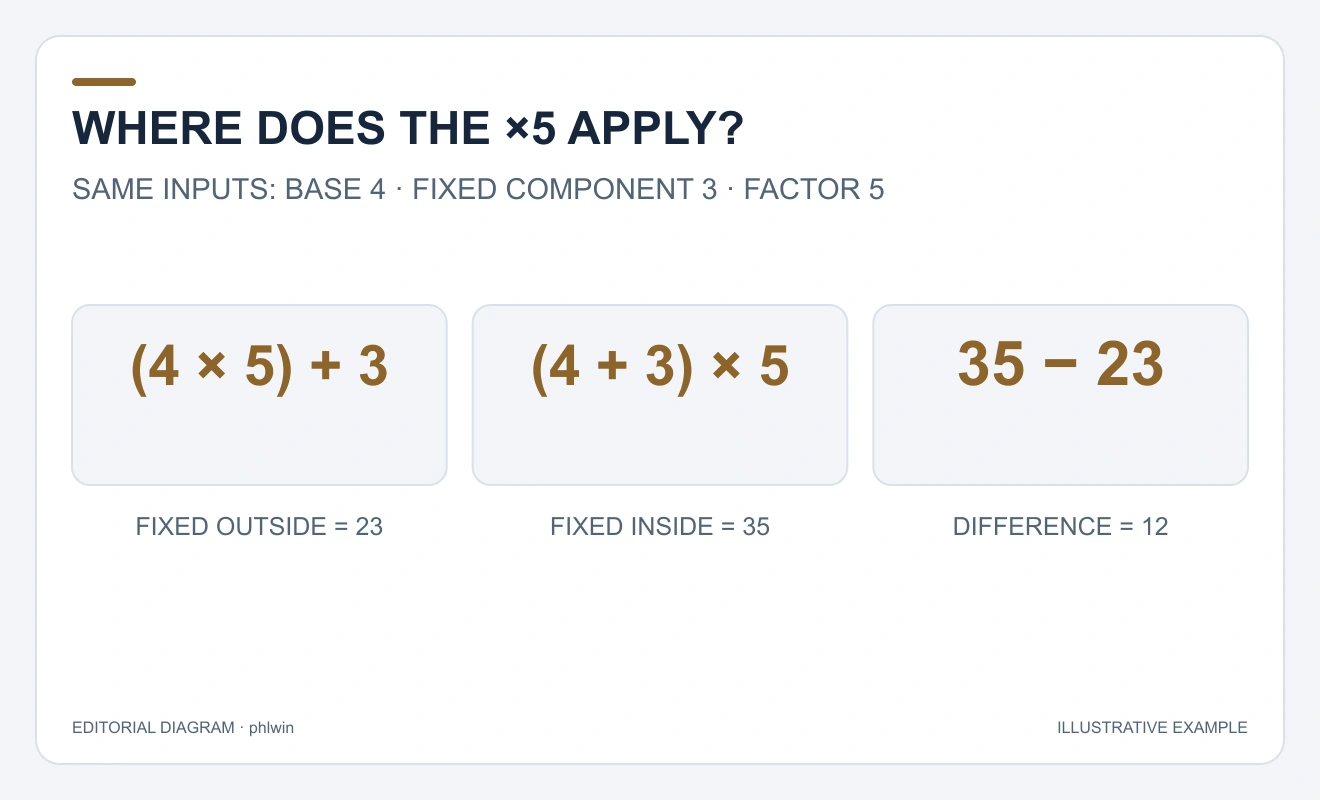
The 12-unit difference is the extra four copies of the 3-unit fixed component in the second rule: 3 × (5 − 1) = 12. Neither formula is universally the correct slot rule. Each matches only its own stated scope.
A counter cannot provide missing parentheses
Seeing 5× beside a total does not establish whether every component is inside its scope. Read the rule for entry prizes, feature awards, fixed credits and jackpot components separately. A cropped display is insufficient to resolve those boundaries.
Python’s expression reference documents operation precedence; parentheses in these original examples make the intended calculation explicit. It is a mathematical reference, not evidence that a game uses Python or either award rule.
Reconcile the component record
List the base, factor, fixed component and provider’s final credited amount. If the rule does not say which components the factor affects, label the calculation unresolved instead of choosing the larger total.
Mark every component as raw or already adjusted
Suppose a record shows “base award 4”, “multiplier 5” and “adjusted award 20”, followed by a separate fixed credit of 3. Under the first stated rule, the adjusted 20 already contains the multiplication. Adding the fixed credit gives 23. Calculating 20 × 5 + 3 = 103 would apply the same multiplier twice.
A compact ledger can use four columns: component name, displayed amount, raw or adjusted status, and whether the final total already includes it. Do not add a summary row to the components it summarizes. If “total win 23” includes both 20 and 3, the return remains 23, not 46.
Return and net change answer different questions
If the fictional accepted round cost was 2 units, the first rule’s 23-unit return would correspond to a net change of 23 − 2 = 21 units. The second rule’s 35-unit return would correspond to 33. These calculations assume a complete, settled round with no other credits or debits and the same unit throughout.
Do not subtract the cost inside the multiplier formula unless the actual instruction specifically defines that base. The example’s factor acts on an award component; it does not act on a wallet balance or a net profit figure.
What evidence resolves the parentheses?
Look for wording that identifies eligible awards and exclusions, plus a breakdown from the completed round. A generic “5×” graphic beside several amounts does not settle the scope. A fixed promotional credit may also belong to a different transaction from the game award, so match references before combining them.
If the documents and record still leave the fixed component’s treatment unclear, retain both candidate totals with their assumptions. Report the confirmed credit separately. Choosing 35 because it is larger would replace a missing rule with a preference; choosing 23 without evidence would be equally unsupported.