
House Bill 10982: what the proposed online gambling ad ban says, clause by clause, and what the fines would be

Short answer — House Bill No. 10982, the proposed “Online Gambling Advertising Prohibition Act of 2026”, was filed in the House of Representatives on 26 August 2026 by Representative Karen Hope F. Garcia (3rd District, Cebu), according to the receiving stamp on the official bill text. It would ban advertising, promotion, endorsement and sponsorship of online gambling across 15 listed channels, regulate (not ban) ads for casinos, PCSO games, horse racing and cockpits, require ID plus biometric checks for every online account, and set operator fines of ₱500,000 to ₱10 million or up to 5 times the value of the ad. It is a bill, not a law: nothing in it applies until both chambers pass it and it is signed and published.
We read the full 35-section text. Below is what it actually says, what would change for players and for the people who market online gaming, and a set of peso examples of how the fines would be calculated.
Who filed it, and why?
The explanatory note argues that mobile phones removed the physical barriers that once kept gambling away from children. It cites PAGCOR figures for 2025: gross gaming revenue of about ₱396.14 billion, with electronic and online gaming growing roughly 30% to ₱201.12 billion and, for the first time, overtaking land-based casinos at 50.77% of the total. Our check: ₱201.12 billion ÷ ₱396.14 billion = 50.77%, so the note’s share is internally consistent. The note also says PAGCOR estimates about ten million Filipinos use licensed online platforms.
The author’s main argument is that PAGCOR’s existing steps — removing billboards, an agreement with the Ad Standards Council, primetime restrictions and a June 2026 order to replace ads with helpline material (see PAGCOR’s announcement of that order) — bind only licensees, can be withdrawn by the regulator and carry no penalties. “What is required is a statute,” the note says.
What would be banned, and what would still be allowed?
The bill draws its line by product, not by operator. Gambling placed remotely on your own device is “online gambling” and its promotion is prohibited. Gambling inside a licensed venue, PCSO draws, horse racing and licensed cockpits are “non-online” and may still advertise under rules. The prohibition applies to government operators as well as private licensees.
| Topic | What HB 10982 says | Section |
|---|---|---|
| Online gambling ads | Prohibited, including bonuses, free bets, deposit matches, jackpots, odds and promo or referral codes | 4 |
| Channels covered | 15, from TV, print and billboards to social media, streaming, search ads, programmatic ads, influencers, affiliates, SMS/email and sponsorships | 5 |
| Celebrity and influencer endorsements | Unlawful for online gambling when paid; sponsorship of teams, events, jerseys and naming rights banned | 8 |
| Shared brands | An ad for a casino or other product using an online brand counts as an online ad unless it has no URL, app name, QR code or sign-up prompt | 9 |
| Free demos | A free-to-play or demo version offered to induce gambling is treated as online gambling for the ad ban | 3(h) |
| Not covered | News, editorial comment, research, art, government and regulator notices, responsible gambling information | 6 |
| Operator’s own platform | Informational messages allowed only to verified account holders, not indexed for public search, with a warning covering 30% of the visual area | 7, 14 |
| Land-based, PCSO, racing, cockpits | Advertising allowed but not near schools (100 metres), not targeted or via influencers/affiliates, warning on 20% of the area | 10–14 |
What would change for players?
For a player the most direct change is in Section 18. No operator could let anyone create or even access an online account without verifying that the person is at least 21, using a government ID or approved digital ID, a check of date of birth, verification against the Philippine Identification System or another authorised database, and a biometric or liveness check. The operator would also have to confirm before each session that the verified holder is the one logging in.
Section 19 limits what can be done with that data. Raw biometric images could not be kept (“match-and-discard”); a template could be kept only in encrypted, non-reversible form and must be deleted within 30 days of account closure; the data could not be used for marketing or profiling; and a data breach would have to be reported to PAGCOR within 72 hours. Section 20 asks PAGCOR to run a national self-exclusion registry and set rules on deposit and loss limits, session limits, cooling-off periods and a ban on credit-funded accounts.
Section 26 is explicit that players are not penalised: no liability attaches to anyone “by reason only of participating in gambling or of accessing or receiving a gambling advertisement”, and no child is penalised under the Act. Chapter VII would require PAGCOR to keep a free 24-hour problem gambling helpline and work with PhilHealth on treatment benefit packages.
How big would the fines be? (our calculation)
The penalty sections mix fixed peso ranges with multiples of the advertising value. For gambling operators and other violators, Section 21 sets a first-offence fine of ₱500,000 to ₱2 million or three times the gross value of the ad placement, whichever is higher; ₱2 million to ₱5 million or three times for a second offence (plus up to 90 days’ licence suspension); and ₱5 million to ₱10 million or five times for a third, with possible revocation.
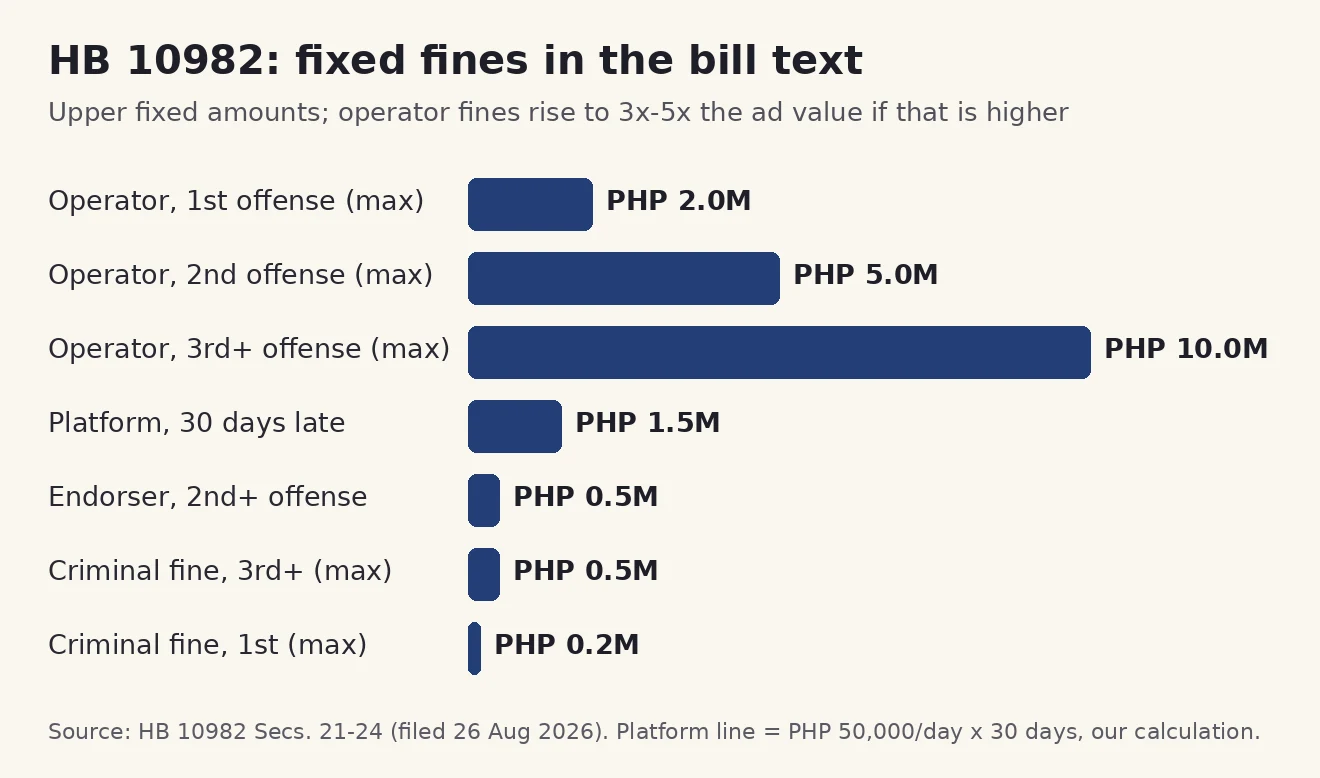
Applied to hypothetical cases — our own examples, not cases from the bill — the arithmetic works like this:
| Hypothetical case | Rule | Result |
|---|---|---|
| Operator’s ₱1,000,000 billboard, first offence | 3 × ₱1,000,000 = ₱3,000,000, higher than the ₱2M top of the range | ₱3,000,000 |
| Operator’s ₱150,000 influencer campaign, first offence | 3 × ₱150,000 = ₱450,000, below the ₱500,000 floor | ₱500,000 to ₱2,000,000 |
| Same ₱1,000,000 billboard, third offence | 5 × ₱1,000,000 = ₱5,000,000, at the range floor | ₱5,000,000 to ₱10,000,000 |
| Endorser paid ₱250,000, first offence | Higher of ₱100,000 or 3 × ₱250,000, plus giving back the fee | ₱750,000 fine + ₱250,000 disgorged |
| Platform ignores a court order for 30 days | ₱50,000 per day | ₱1,500,000 |
Willful violations of the core ad, channel, endorsement and shared-brand sections can also be crimes under Section 22: up to one year in jail or a fine of up to ₱200,000 for a first offence, rising to two to three years or up to ₱500,000 for a third. Corporate officers are liable only if they knowingly took part or deliberately failed to prevent the violation; foreign nationals would be deported after serving sentence.
How would enforcement and blocking work?
Online platforms, ad-tech firms, agencies, media, internet providers and app stores would have to refuse online gambling ads for users in the Philippines, act on public reports within 72 hours and publish twice-yearly enforcement reports. Blocking a website or account would need a court: PAGCOR, the DOJ Office of Cybercrime, DICT or CICC would apply to a designated cybercrime court, which must act within 24 hours. Orders last 30 days and can be extended, must use the narrowest technical measure, and can be challenged, with the motion resolved within 5 days. The explanatory note says this design responds to the Supreme Court’s 2014 Disini ruling, which struck down blocking without a judicial finding.
Enforcement would be split: PAGCOR for its licensees and its own operations, the DTI for advertisers and media outside PAGCOR’s licensing, the PCSO, racing commission, Games and Amusements Board and local councils for their activities, and the MTRCB for broadcast content.
Key deadlines in the text
- Effectivity: 15 days after publication in the Official Gazette or a newspaper (Sec. 35).
- Implementing rules: within 90 days, by PAGCOR and the DTI; delay does not suspend the law (Sec. 31).
- Existing contracts: may be wound down for at most 1 year; no new or renewed ad deals in that period (Sec. 32).
- Sponsorship marks: removed within 30 days of effectivity or notice (Sec. 8).
- School curriculum: responsible gambling education within one school year (Sec. 27).
- Review: Congress reviews the law after 3 years and every 3 years after that (Sec. 30).
What is not yet known
We could not open the House’s legislative status pages on 22 October 2026 (the site blocked automated access), so we have not confirmed the committee referral or any hearing date; the filing date comes from the stamp on the document itself. A separate Senate proposal on gambling ads has been reported, including by Philstar on 2 August 2026; any final law would need both chambers to agree on one text, which could differ from this bill. Fines, channels and the biometric rule may all change in committee.
For now the rules players live with are PAGCOR’s: online gaming is for adults 21 and over, on licensed platforms only. PAGCOR’s responsible gaming page explains its code of practice and the player exclusion programme.
Sources (checked 22 October 2026): House Bill No. 10982 official text, House of Representatives document server (stamped 26 August 2026); PAGCOR announcement on replacing gambling ads with helpline materials; Philstar report of 2 August 2026 (reported, not a primary source); PAGCOR responsible gaming page. The share check, fine examples and the 30-day platform figure are our own calculation from the bill text.