
A roulette split covers two numbers but pays one accepted wager
A split in roulette covers two neighbouring numbers on the betting layout. If either covered number wins, the split is evaluated once as the accepted wager. The two-number coverage does not mean two separate winning stakes are created.
For the topic overview, see Round identifier for clear settlement.
This distinction is easiest to see by writing the chip once, then listing the two outcomes that can satisfy its condition.

One chip, a two-outcome condition
The PlayNow roulette guide identifies a split as a selection between two numbers. The example here uses the adjacent layout numbers 1 and 2. The split is one 10-unit entry with coverage {1, 2}; it is not 10 on 1 plus another 10 on 2.
Assume only that entry exists. A result of 1 or 2 satisfies it. A result of 3 does not. A wheel produces one result for the evaluated spin, so both 1 and 2 do not land together.
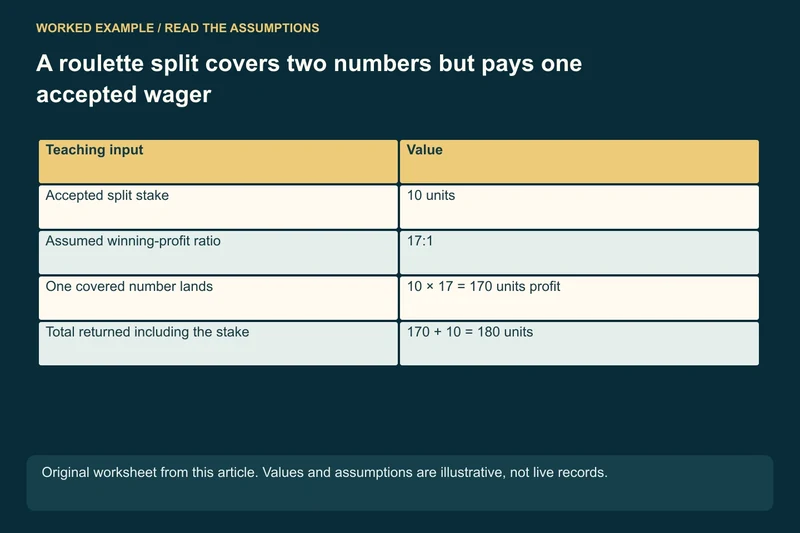
Follow an explicitly invented payment row
| Teaching input | Value |
|---|---|
| Accepted split stake | 10 units |
| Assumed winning-profit ratio | 17:1 |
| One covered number lands | 10 × 17 = 170 units profit |
| Total returned including the stake | 170 + 10 = 180 units |
The 180-unit return is counted once. Multiplying it by two because the split covers two numbers would invent a second accepted wager. Dividing the accepted stake into two straight-up entries would instead substitute a different bet structure and a different payout rule.
A split and two straight-ups can look nearby on the layout
Location matters. One chip straddling the dividing line records a different selection from a chip placed inside each number box. A small photograph may not show that placement clearly. Keep the explicit bet-type label from the history when available.
If two straight-up entries really were accepted, preserve their separate stakes. Do not collapse them into a split merely because their covered set also contains two numbers. Same coverage does not establish the same total cost or payment structure.
Read the final stake state before using the worksheet
An interface may show a chip value used for the next placement as well as a total already accepted. The control value alone does not prove the stake on the split. Additional chips, undo actions or other selections can change that total.
Record the game variant, selected numbers, bet type, accepted amount and paytable ratio together. The calculation then answers a narrow settlement question under stated assumptions; it supplies no prediction about the next pocket.
The phlwin homepage brings together the site’s other reading topics.
Source-based editorial research and original examples. Sources checked 9 October 2026. No real-money play or account transaction was performed for this article.