
GUIDE · phlwin
Aztec Smash: why the multiplier jumps from 100 × to 200 ×
Aztec Smash uses a change of step size in its published Smash Multiplier description. The feature progresses in tens up to 100 ×, then in hundreds. Reading 100 × as merely another step toward 110 × misses that threshold.
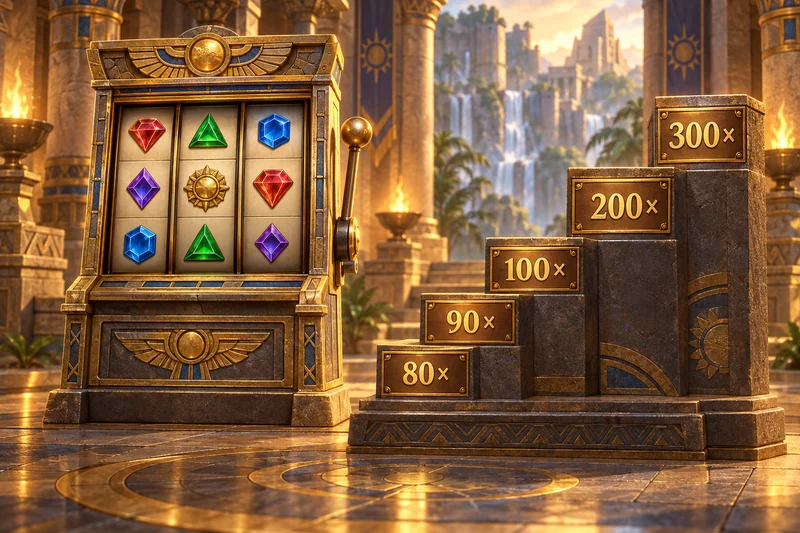
Read the increment as well as the displayed value
The official Aztec Smash overview, checked on 8 October 2026, describes a starting value of 10 ×, increases of 10 × until 100 ×, then increases of 100 × toward 1,000 ×. This is the published progression rule; it does not say how often a reader will encounter each stage.
A meter value answers “where is the multiplier now?” The increment answers “what is the next change under this stage’s rule?” Those are separate pieces of information. A progression can change its step size without changing the meaning of the multiplication sign.
Follow a hypothetical stretch across the boundary
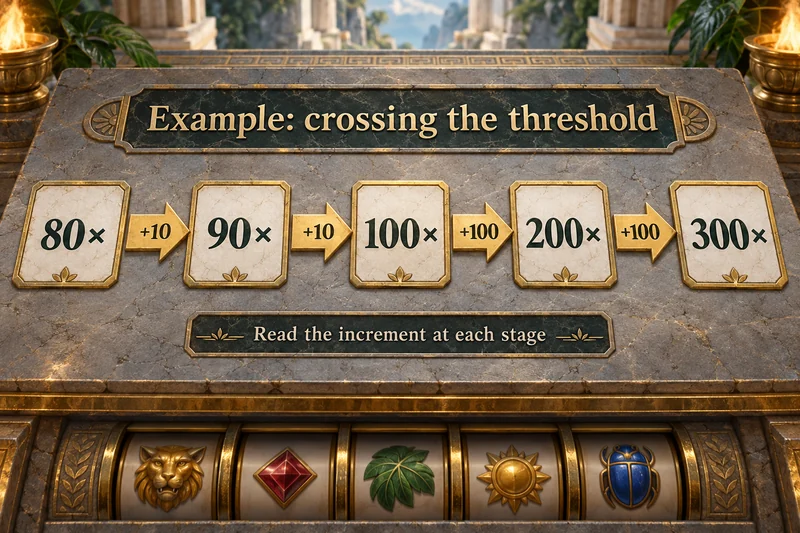
Assume we begin observing a qualifying sequence with the meter at 80 ×. Count only events that advance this meter under the published progression. The following is an arithmetic walkthrough, not a recorded spin or prediction.
| Advances since the starting point | Meter value | Change just applied |
|---|---|---|
| 0 | 80 × | Starting observation |
| 1 | 90 × | + 10 × |
| 2 | 100 × | + 10 × |
| 3 | 200 × | + 100 × |
| 4 | 300 × | + 100 × |
There are four advances from 80 × to 300 × in this exercise. Dividing the 220 × difference by 10 × gives 22, but that shortcut assumes a constant increment. The table shows exactly where that assumption stops being true.
A larger step does not identify a larger cash award
The sequence above tracks a feature state. It does not identify the award to which the multiplier applies, nor does it establish that every visible change earns money. A cash calculation still needs a qualifying result, its base award, and the rules governing the multiplier’s scope.
For that separate question, the eligible-award multiplier example explains why multiplying an excluded component changes the answer incorrectly. The threshold table should not replace that scope check.
Nor should the rising numbers be read as a schedule of future outcomes. Knowing the value after a specified number of qualifying advances does not tell us how many such advances will occur. This article calculates a conditional sequence only.
How to annotate a multiplier record
Write down the title and feature, the current value, the trigger being counted, and the increment applicable at that value. If the next record looks surprising, compare it with the stage rule before calling it an arithmetic error. A jump from 100 × to 200 × fits the published progression; a jump observed in some other feature needs its own rule.
Keep missing information visible. “Meter reached 200 ×; associated award not shown” is a useful record. “Won 200 times the balance” introduces both an award and a stake basis that the meter alone cannot establish.
The slot mechanics collection contains related examples. The phlwin homepage provides the wider topic navigation.
Source-based editorial research and original examples. Sources checked 2026-10-08.