
There are 2× and 3× on the screen: when is the total 34, and why not 40 or 50?
The visible multiplier is not enough to calculate the payout. Need to know which values are combined and which award is covered. In the example here, only 6 is multiplied; there is a separate 4 that does not belong to the multiplier rule.

Do the calculation on the eligible base, then add the other award. If the range is wrong, correct multiplication will not fix the answer. The four that must be related in the note are base amount, eligible combination, method of combining multipliers and duration of their validity.
The scope can vary even within the same game
In Pragmatic Play’s Wild West Duels information sheet, page 5, combines multipliers with the winning line of the Duel Feature. In Lost Relic section on page 6, the description is different: there is a global win multiplier of 1 plus the accumulated multiplier increments from the pick stage.
The two descriptions have different rule scopes. The operation should not be taken from one feature and the base from the other. The next values are fictitious inputs to show the effect; they are not replays of Wild West Duels or the result of attempted operators.
Worked example: 6 are eligible, there are 4 separate
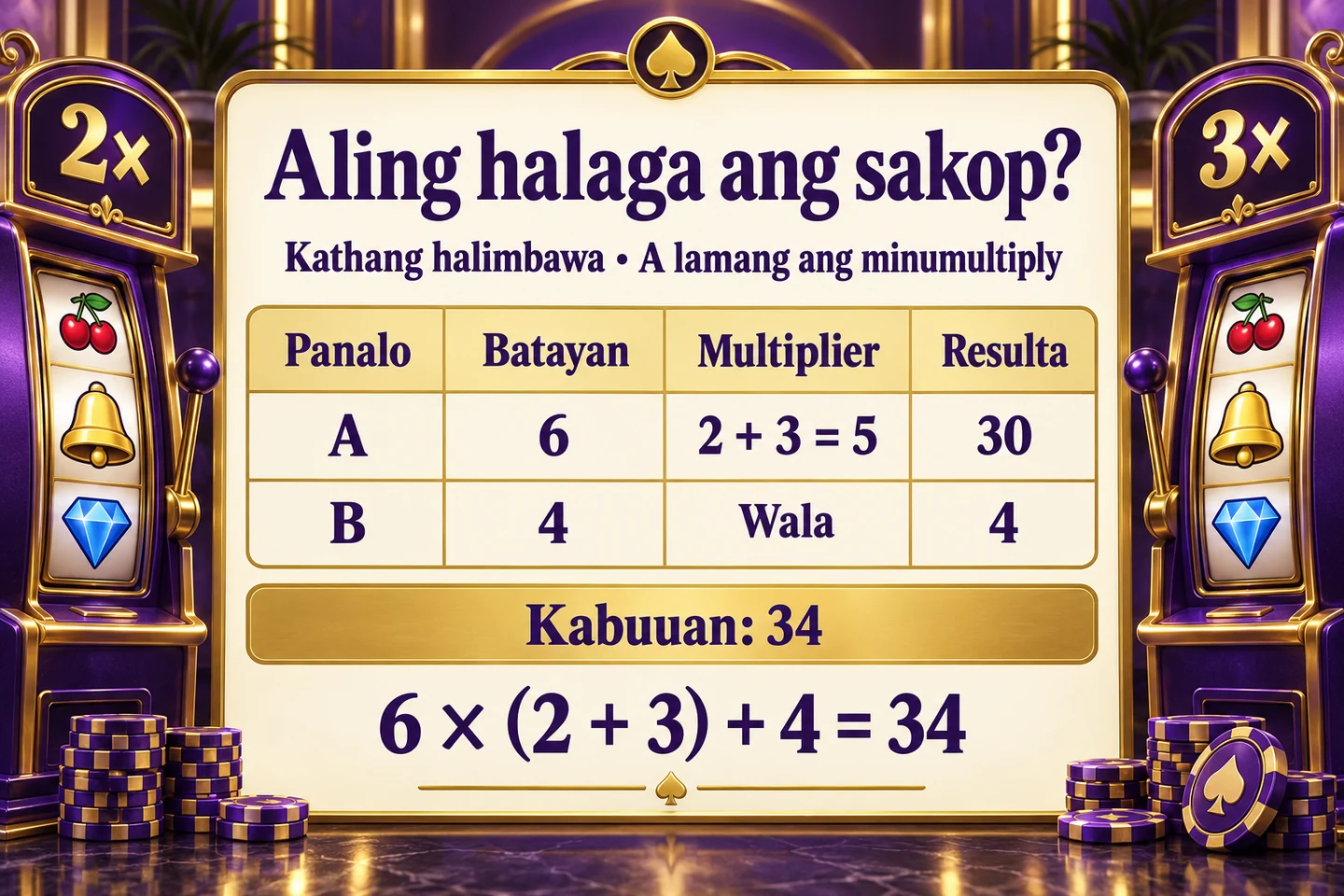
Assume a simple model with two awards before the multiplier: award A = 6 units and award B = 4 units. In this model, only A is covered by the two multipliers of 2× and 3×. The rule is combine their values before applying to A. B has no feature multiplier, so it remains 4.
| Award | Base before multiplier | Eligible multiplier | Calculation | Result |
|---|---|---|---|---|
| A | 6 units | 2+3=5 | 6×5 | 30 units |
| B | 4 units | No feature multiplier | 4×1 | 4 units |
| A total of two awards | Add after applying the correct scope | 30+4 | 34 units | |
The total is 6 × (2+3) + 4 = 34. This is not net profit: we do not provide paid stake, other transaction or session balance. It also does not show the probability of any award.
Why does it appear as 40 or 50 when the reading is wrong?
If what is done is 6×2×3+4=40, the operation was changed. 2 and 3 are multiplied by each other even though addition is the set rule. The arithmetic of the expression is correct, but the expression is incorrect.
If what was done was (6+4)×(2+3)=50, scope changed. Award B is affected by the multiplier even though it is not eligible in the model. The extra 16 is from increasing B from 4 to 20.
It’s important to separate the two errors because help or support need to clarify different things: “How are the values combined?” for the first; “Which award is covered?” for the second. The question “Why didn’t everything become 5×?” is not enough. if the eligible base has not yet been recorded.
If the actual rule is multiplication or global coverage, another expression may be correct. 34 is not a universal formula. The purpose of the worksheet is to show which assumption changes the answer.
A different worksheet when global is described
For the second fabricated model, assume that the collected multiplier increments are +2 and +5, with a starting 1, and that the final global value is 1+2+5=8. Also assume that both 6 and 4 base awards are eligible. In that condition, the calculation is (6+4)×8=80.
It is not an extension of the first 34-unit model. A different rule and a different scope were assumed. Do not take the 30 already multiplied on the first worksheet and multiply by 8 again unless the actual rules explicitly allow two stages of multiplication.
The same with the displayed total: if the field is a final multiplier of 8, do not repeat the addition of the starting 1 and increments. If the field is collected increments of 7, then it is necessary to determine if the starting value is separate. The label and stage of the display make it clear, not just the numeral.
The paytable award before the feature, the award after the feature and the total round win are three different possible bases. In its own note, label each one so that the same amount is not multiplied twice.
Record the boundary of the rule, not just the peak value
The multiplier can be scoped as a line, spin, tumble sequence or full feature. The reset condition is a separate detail: what event ends the effect, what value does it start with, and when is it displayed? If it’s not clear from the document, mark the reset as unknown instead of carrying the last found value into the new round.
A progression can also change its step size; the Aztec Smash threshold example shows where ten-unit increments become hundred-unit increments.
Use this format in the note: “Title/mode; eligible award; base before operation; combine rule; final multiplier; scope end.” For the first model: “Fictitious line example; A only; 6 units; 2+3; 5×; on specified award only.” For the second: “Fictional global example; A and B; 10 units; 1+collected increments; 8×; in the specified feature model.”
When an actual payout is in question, match the rule with the full game title, feature state, round identifier and timestamp. A cropped multiplier badge without a base or result record is not enough. A new paid round is not required to clarify the document.
May checklist for missing multiplier details and explanation of multiplier scope and reset. Also open the slots hub and guide library in phlwin homepage. For correction in the article, use the phlwin contact; for account settlement, verified operator support is required.
The two worksheets and images are self-educational examples. No provider integration, active operator configuration, betting transactions or payouts were attempted in the creation of the guide.