
Bingo free centre: four calls can fill one line, but not every line
A free centre can count as one marked square in a line that passes through it. It does not replace a missing number in a different row. Read the pattern’s positions before deciding what a four-number call list means.
This example expands the phlwin guide to bingo patterns and card confirmation. We use one invented 5-by-5 card with an already marked centre and a declared horizontal-line rule. No actual card, room or prize is represented.
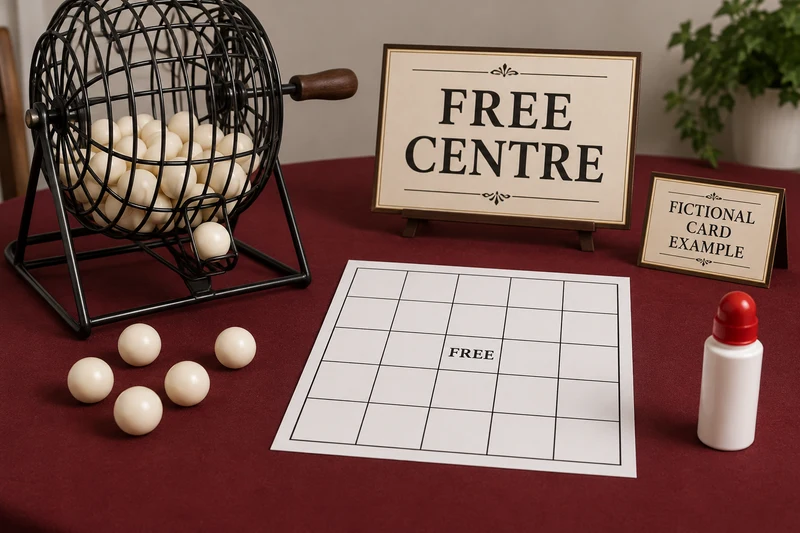
Keep the free square in its actual position
Mecca’s 75-ball bingo guide describes a 5-by-5 ticket with 24 numbered squares and a blank centre that counts as marked when it lies on a line. That is context for the card format; the fictional card, call lists and comparisons below are our own work. A particular product’s active pattern and validation rules still need its own help screen.
| B | I | N | G | O |
|---|---|---|---|---|
| 05 | 18 | 31 | 49 | 63 |
| 08 | 22 | 36 | 53 | 70 |
| 12 | 26 | FREE | 58 | 67 |
| 03 | 17 | 40 | 47 | 72 |
| 14 | 29 | 44 | 60 | 74 |
The middle row contains four numbered squares and the free centre. The first row contains five numbered squares. Both have five positions, but they do not require the same number of calls to mark those positions.
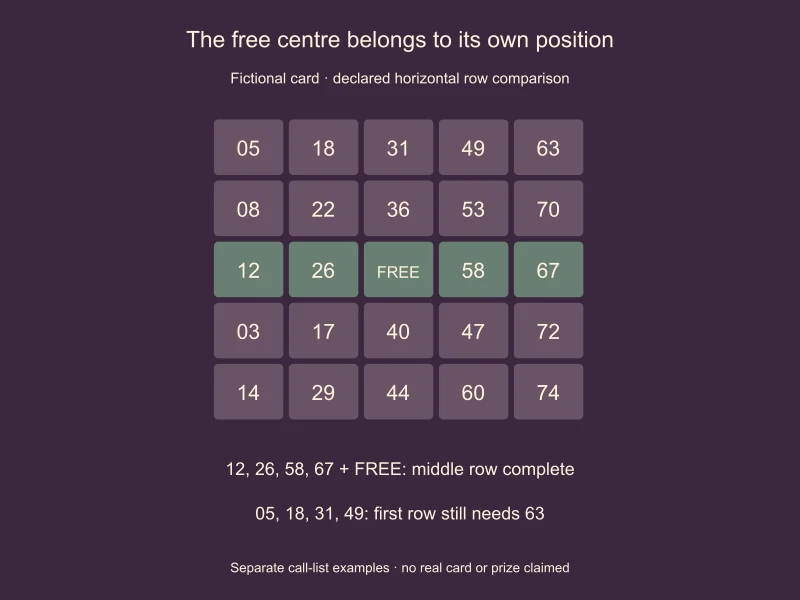
Four calls complete the middle row in this example
Suppose the called values are 12, 26, 58 and 67. They mark all four numbered squares in the middle row. Together with the already marked centre, all five positions of that row are marked.
There are four called values and five marked positions in that row. The free centre is not a fifth call and has no drawn number. Do not insert 00, a repeated number or an invented call into a result list merely to make the two counts agree.
The same count does not complete the first row
Now consider a separate call list: 05, 18, 31 and 49. Four squares in the first row are marked, but 63 is missing. The centre belongs to the third row; it cannot be moved up to cover the missing 63.
Adding a call of 63 completes the first row. This second example needs five calls for that row because none of its five positions is the free square. “Four calls” alone therefore cannot determine whether a line is complete.
| Separate fictional case | Required row | Result |
|---|---|---|
| 12, 26, 58, 67 | Middle row including FREE | Five positions marked |
| 05, 18, 31, 49 | First row | 63 missing; row incomplete |
| 05, 18, 31, 49, 63 | First row | Five positions marked |
A marked line is not automatically the active winning pattern
Our exercise declares the relevant horizontal row. An actual room may require another line, a specified shape or all numbered squares. Completing the illustrated middle row does not establish any of those other conditions.
For a full-card pattern on this example, four called numbers remain far short of the 24 numbered squares. The centre contributes its one fixed position; it does not mark the other 20 numbered squares. Card acceptance, timing and automatic or manual claim validation also remain separate from drawing a line on a diagram.
Store positions and calls as different fields
Keep the card ID, row-and-column layout, declared pattern, free-square rule, session and called values. A plain total of marks loses the information needed to verify the pattern. Preserve the original card rather than combining marks from different cards.
The number-pair and digit-record guide explains why raw number-game formats must remain intact. A bingo card adds another kind of structure: a number’s location on a grid. Do not treat its marked positions as a two-number result or a three-digit sequence.
We checked the 24 distinct values, column ranges and all three row comparisons on 10 October 2026. All card values and calls are fictional; no play, ticket, prize payment or operator availability was tested.